

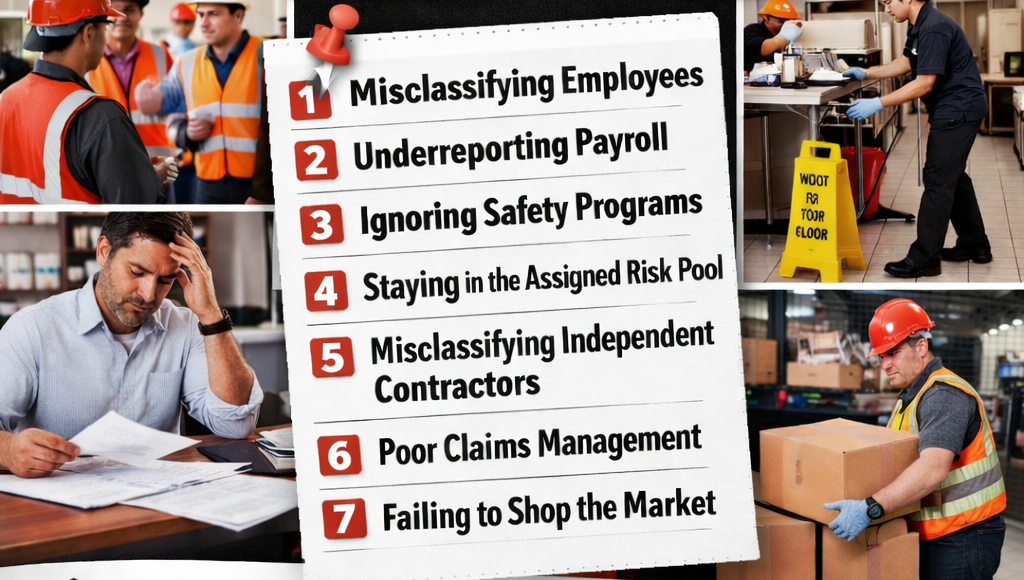
Top 7 Workers’ Comp Mistakes Minnesota Business Owners Make (And How to Avoid Them)
Workers’ compensation insurance protects your employees and your business. In Minnesota, however, costly mistakes are common. Avoiding these errors can save you significant amounts in premiums, penalties, and administrative challenges, regardless of your industry or location.
Below are the top seven workers’ compensation mistakes Minnesota business owners make, along with strategies to avoid them.
1. Misclassifying Employees
Each job role has a classification code that determines your workers’ compensation rate. In Minnesota, accurate classification is critical. Misclassifying employees, whether intentional or not, can result in significant audit adjustments and unexpected costs.
Example:
For example, classifying a roofing employee as general labor significantly understates your risk exposure.
How to avoid it:
Partner with an experienced independent insurance agency that understands Minnesota-specific classifications and conducts annual payroll reviews.
2. Underreporting Payroll
Estimating a lower payroll to save money upfront often results in higher costs after your audit.
What happens:
At the end of your policy term, insurers audit your actual payroll. Underreporting leads to substantial additional premiums.
How to avoid it:
Use accurate payroll projections or consider a pay-as-you-go workers’ compensation plan that adjusts premiums in real time.
3. Ignoring Workplace Safety Programs
Safety programs are essential, as they directly affect your claims history and premiums.
Why it matters:
An increase in claims raises your experience modification factor, resulting in higher premiums.
How to avoid it:
- Conduct regular safety meetings.
- Provide proper PPE (personal protective equipment)
- Document all training
- Create a culture of safety.
Insurance carriers often offer better pricing to proactive businesses.
4. Staying in the Assigned Risk Pool Too Long
Many Minnesota businesses begin in the assigned risk pool, particularly if they are new or have a claims history. This option is typically more expensive and provides fewer choices. The servicing providers for the Minnesota Workers’ Compensation Insurers Association are currently: Superior Point and Old Republic Residual Marketplace
The mistake:
Assuming you must remain in the assigned risk pool indefinitely.
How to avoid it:
You may qualify for the standard market sooner than expected. Businesses that improve safety, reduce claims, and maintain clean operations can often transition out and save 10 to 20 percent or more.
If you have Superior Point or Old Republic Residual Marketplace we recommend you call us immediately at 651-212-7157.
5. Misunderstanding Independent Contractor Rules
Minnesota enforces strict criteria for independent contractor status. Misclassification is a significant compliance risk for business owners.
The risk:
If a contractor is injured and does not meet the independent criteria, you may be liable for claims and penalties.
How to avoid it:
- Verify contractor status carefully.
- Require certificates of insurance (COIs)
- Keep documentation on file.
When uncertain, it is safer to assume coverage is required.
6. Poor Claims Management
How you manage claims can affect your business for years. Delayed reporting or insufficient follow-up can significantly increase claim costs.
Why it matters:
Your experience modification factor is heavily influenced by claims history, which directly affects your premium.
How to avoid it:
- Report claims immediately.
- Stay involved in communication.
- Use return-to-work programs
- Partner with carriers that provide strong claims support
Prompt, proactive management can reduce long-term costs.
7. Failing to Shop the Market
A common mistake among Minnesota business owners is renewing their policy annually without exploring alternative options.
What you’re missing:
- Better pricing
- Dividend programs
- Improved coverage
- Industry-specific carriers
How to avoid it:
Partner with an independent agency that can compare multiple top-rated carriers on your behalf. Increased competition leads to better results.
The Importance of Minnesota Businesses
Workers’ compensation is not only a legal requirement in Minnesota but also a key financial strategy. For all business types, having the correct structure in place can mean the difference between controlled costs and ongoing overpayment.
Most of these mistakes are entirely avoidable with proper guidance.
✅ Call to Action: Get a Free Workers’ Comp Review
If you are a Minnesota business owner, now is an ideal time to review your workers’ compensation policy.
📞 Call 651-212-7157 today for a fast, free review
✔ See if you’re overpaying
✔ Check if you qualify for better rates
✔ Ensure your coverage is set up correctly
Save money, reduce risk, and protect your team.
❓ Frequently Asked Questions (FAQs)
1. Is workers’ compensation required in Minnesota?
Yes. Most Minnesota businesses with employees are required by law to carry workers’ compensation insurance, even if you only have one employee.
2. How is workers’ comp cost calculated in Minnesota?
Premiums are based on:
- Employee classification codes
- Total payroll
- Claims history (experience mod)
- Industry risk level
3. What is the assigned risk pool in Minnesota?
It’s a state-managed insurance option for businesses that can’t find coverage in the standard market. It’s typically more expensive and less flexible. If you have a Superior Point or an Old Republic Residential Marketplace policy, call us immediately.
4. Can I exclude independent contractors from coverage?
Only if they meet Minnesota’s strict definition of an independent contractor. Otherwise, you may still be responsible for covering them.
5. How can I lower my workers’ compensation premiums?
- Improve workplace safety
- Manage claims effectively
- Ensure proper classifications
- Shop multiple insurance carriers.
6. How often should I review my workers’ comp policy?
At least once per year—or anytime your payroll, operations, or staffing changes significantly.
Leave a Comment